
Company Formation in the Netherlands

REGISTER YOUR COMPANY IN THE NETHERLANDS — EUROPE’S LEADING TRADE AND LOGISTICS HUB
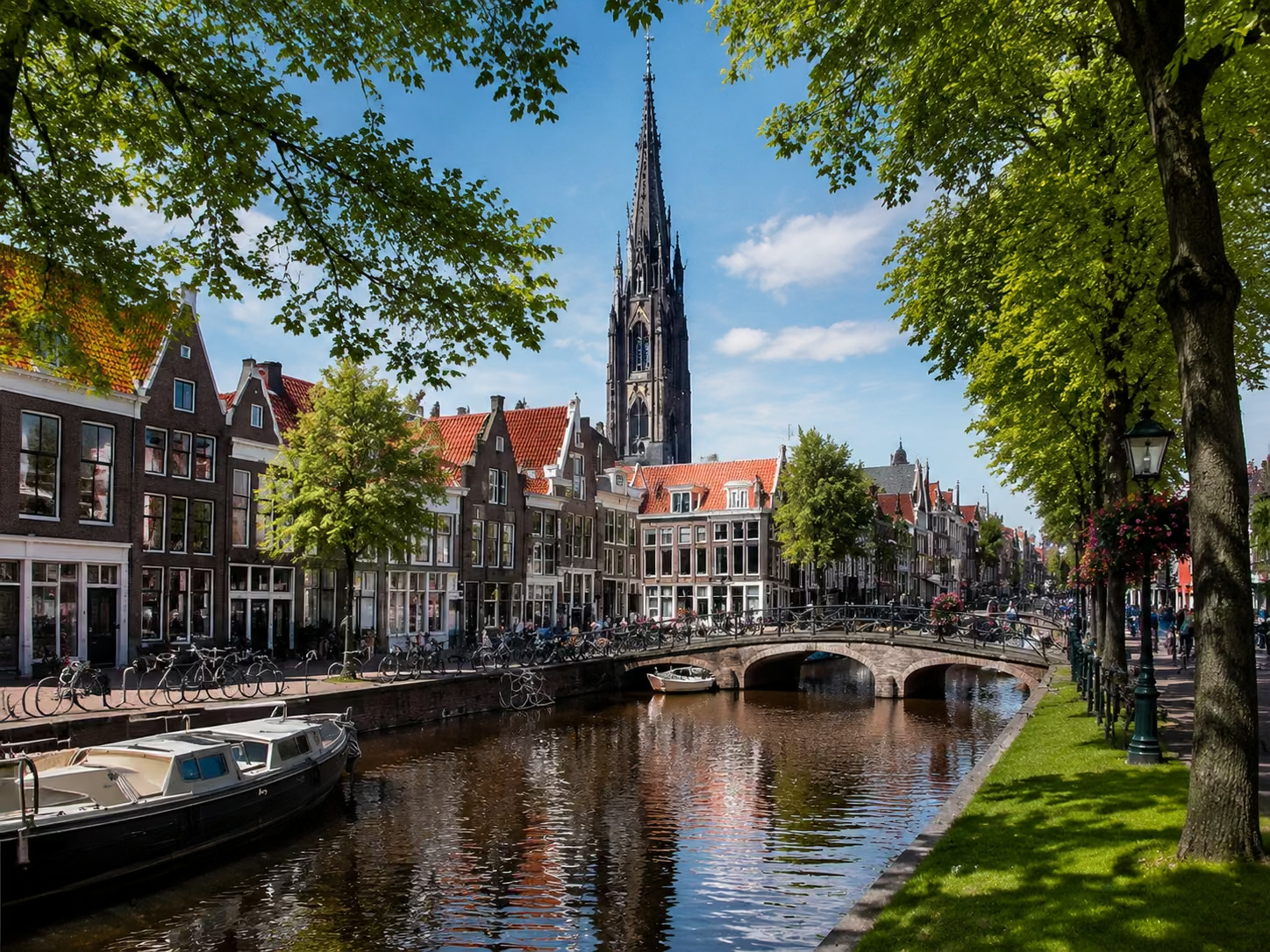
OVERVIEW

Incorporation in the Netherlands

The Netherlands is one of Europe’s most strategic and internationally respected business jurisdictions, consistently ranked among the top destinations for foreign direct investment in the EU. Home to the Port of Rotterdam — Europe’s largest port — and Amsterdam Schiphol Airport, the Netherlands serves as the primary gateway for goods and services entering and leaving Europe. The country is a global leader in logistics, financial services, technology, agriculture, and energy, and offers one of the EU’s most extensive double tax treaty networks covering over 90 countries. A Dutch BV carries immediate credibility with international banks, clients, and investors. Company registration is fully remote via a notary video call, with no travel to the Netherlands required.

Why the Netherlands?

Requirements

General Requirements for Netherlands Company Formation

01

Company Name

Must be unique and not identical or misleadingly similar to an existing name in the KVK Business Register. Must include the suffix BV or NV. Cannot suggest affiliation with the Dutch Royal Family or government authorities.

02

Entity Type

BV (most common for foreign investors), NV, or Branch Office (Bijkantoor)

03

Registered Office Address

A physical Dutch business address is mandatory for all BV companies. CORPEASE provides a registered office address service in the Netherlands.

04

Minimum Share Capital

From €0.01 for BV — at least one share must be issued at incorporation. In practice, €1 to €100 is commonly used. €45,000 for NV, of which 20% must be paid up at registration.

05

Minimum Shareholders

1 shareholder for BV. 1 shareholder for NV.

06

Minimum Directors

1 director for BV. No Dutch residency or citizenship required.

07

Foreign Ownership

100% foreign ownership permitted. No local Dutch partner, shareholder, or director is required.

08

Owner Identification

1. Certified Copy of a Passport 2. Certified Copy of a Utility Bill (e.g., Gas / Electricity) or Bank Statement (dated within the last 3 months) 3. Selfie (photo of the owner holding their passport)

09

Statuten (Articles of Association)

Drafted by a Dutch civil law notary and filed with the KVK. The notary process is completed fully remotely via an online video call — no travel to the Netherlands is required.

10

Document Requirement

A Power of Attorney (POA) with handwritten signature is accepted for remote signing. The incorporation deed (Akte van Oprichting) is signed before a Dutch civil law notary via online video call. CORPEASE coordinates the full notary process on your behalf.

11

UBO Registration

All BV companies must register their Ultimate Beneficial Owners (UBOs) in the Dutch UBO Register held by the KVK. Any natural person holding more than 25% of shares, voting rights, or economic interest must be registered.

12

Tax Registration

Corporate income tax registration and VAT (BTW) registration are coordinated with the Belastingdienst (Dutch Tax Administration) after KVK registration. VAT registration is typically completed within 1–2 weeks after KVK approval. Both VAT and EORI registration are included in all CORPEASE packages.

13

Article 23 VAT Deferment (Optional)

Companies engaged in importing goods into the Netherlands or EU can apply for an Article 23 license, which allows import VAT to be deferred and declared via the periodic VAT return rather than paid at the border. This is a significant cash flow advantage for import businesses and is included in the Premium package.
COMPANY TYPES

Which Company Types We Serve

01

BV — Besloten Vennootschap (Private Limited Company)

The most common and recommended entity type for foreign investors and international businesses in the Netherlands. The BV offers limited liability, flexible governance, no meaningful minimum share capital, and full foreign ownership. It is the Dutch equivalent of a GmbH or SRL and is widely used for trading companies, holding structures, and international operations. Incorporation requires a Dutch civil law notary, which can be completed fully remotely via an online video call.
Best for:
  • Foreign entrepreneurs and international investors entering the Netherlands
  • Trading companies, e-commerce, technology, and logistics businesses
  • Holding company and group structures
  • Companies seeking a globally recognised EU entity with strong treaty access
  • Import and export businesses requiring Article 23 VAT deferment

02

NV — Naamloze Vennootschap (Public Limited Company)

The Dutch equivalent of a public limited company. An NV requires a minimum share capital of €45,000 and is suitable for larger corporations or companies planning to list on Euronext Amsterdam. It has a more complex governance structure than a BV and is subject to stricter regulatory requirements.
Best for:
  • Large corporations planning to raise public capital or list on a stock exchange
  • Businesses requiring a formal public company governance structure
  • Joint ventures between large corporate entities

03

Bijkantoor (Branch Office)

An extension of a foreign parent company operating in the Netherlands. Not a separate legal entity — the parent company remains fully liable for its obligations. Suitable for foreign companies establishing a Dutch presence without incorporating a new entity.
Best for:
  • Foreign companies testing the Dutch market before full incorporation
  • Businesses preferring a single legal entity with a Dutch operational presence
  • Short-term or project-based Dutch operations
Comparison

BV vs NV vs Branch — Which Structure Is Right for You?

BV

NV

Branch

Best for

SMEs, foreign investors, holding structures

Large corps, listed companies

Foreign extension

Min. share capital

€0.01 (no meaningful minimum)

€45,000 (20% paid up at registration)

None

Min. shareholders

1

1

N/A (parent only)

Min. directors

1 (no residency requirement)

Board of Directors (min. 1)

1 representative

Foreign ownership

100% permitted

100% permitted

Parent company

Corporate tax

19% up to €200K; 25.8% above

19% up to €200K; 25.8% above

19% up to €200K; 25.8% above

Notary required

Yes — via video call (remote)

Yes — via video call (remote)

No

Public share issuance

No

Yes

No

Article 23 VAT deferment

Available

Available

Available

Formation time

2–4 weeks

3–6 weeks

2–3 weeks

Recommended for foreign clients

First choice

If raising public capital

Market testing

Our Recommendation

For the majority of foreign entrepreneurs and international investors, the GmbH is the most recognized, credible, and practical entity type in Germany. If you are launching with limited capital, the UG offers a low-cost alternative that can be converted to a GmbH over time. Our advisors will assess your situation and recommend the most suitable structure — free of charge.

Process

From Enquiry to Operation — Formation Timeline: 2–4 Weeks

A clear, predictable process — so you always know what happens next.

01

Step one

Free Consultation

We assess your business needs, recommend the right entity type (BV, NV, or Branch), and provide a full transparent quote. No obligation, no charge.

02

Step Two

Document Preparation & Notary Coordination

We prepare all incorporation documents — Statuten (Articles of Association), shareholder resolution, director appointment, and UBO declarations.

03

Step Three

Remote Notary Signing via Video Call

All shareholders and directors sign the incorporation deed before the Dutch civil law notary via an online video call. No travel to the Netherlands is needed. CORPEASE guides you through the video call process step by step.

04

Step Four

KVK Registration

The notary registers the BV directly in the KVK Business Register (Kamer van Koophandel) on your behalf. Upon registration, your company receives its unique KVK number and is officially listed in the Dutch Business Register.

05

Step Five

Tax Registration, VAT & EORI

Following KVK registration, the Belastingdienst is automatically notified and issues a corporate tax number. VAT (BTW) registration and EORI registration are applied for separately and completed within 1–2 weeks. For Premium clients, an Article 23 VAT deferment application is submitted concurrently. Total formation timeline: 2–4 weeks.
Annual Requirements

Ongoing Annual Obligations

All Dutch BV companies are required to meet the following annual compliance obligations. CORPEASE tracks all deadlines and can manage filings on your behalf.

01

Annual Financial Statements

BV companies must prepare annual financial statements and file them with the KVK Business Register within 8 days of adoption. Filing deadline is generally 13 months after the financial year end. Costs vary based on company size, number of transactions, and complexity.

02

Corporate Income Tax Return

Annual return filed with the Belastingdienst. Corporate tax rate: 19% on profits up to €200,000; 25.8% on profits above. Due within 5 months of financial year end (extendable with a tax advisor).

03

VAT Returns (BTW)

Monthly or quarterly BTW returns filed with the Belastingdienst. Standard VAT rate 21%; reduced rate of 9% for certain goods and services; 0% for qualifying exports and intra-EU transactions.

04

UBO Register Updates

Any changes to beneficial ownership (shareholders holding over 25%) must be updated in the KVK UBO Register promptly. Failure to maintain accurate UBO information is a criminal offence under Dutch law.

05

Article 23 License Renewal

For companies holding an Article 23 VAT deferment license, periodic compliance with Belastingdienst requirements is necessary to maintain the license. CORPEASE monitors and manages this on your behalf.

06

Office Address Renewal

Registered office address must be maintained at all times.

07

Payroll & Social Security

Companies with employees must register for payroll tax and social security contributions with the Belastingdienst. Employer contributions typically add 24–36% on top of gross salary.
Pricing

See our price list & choose your plan

All prices are in US Dollars. Government fees, notary fees, and third-party costs are included where specified. Both packages include VAT and EORI registration.

Standard

Starting from

US$ 5,999

Includes:

Not included:

Premium

Starting from

US$ 7,599

Everything in Standard, plus:

Recommended for international clients engaged in importing goods into the Netherlands or EU who require VAT deferment at the border.

Annual Compliance Services

You can reach out to a customer support representative or send us an email. We will respond to your request at the earliest time possible.

Under 0 transactions

per month

Starting from

US$ 5,000/year

You can talk to a customer support representative or send us an email to one of the following addresses. We will respond to your request at earliest time possible.

1-50 transactions

per month

Starting from

US$ 8,000/year

You can talk to a customer support representative or send us an email to one of the following addresses. We will respond to your request at earliest time possible.

Connect with our Experts

Costs vary based on company size, number of transactions, and complexity. Connect with our Experts — you can reach out to a customer support representative or send us an email. We will respond to your request at the earliest time possible.

FAQs

Frequently Asked Questions

Can a foreigner own 100% of a Dutch BV?
Yes. Dutch law permits 100% foreign ownership of a BV. There is no requirement for a local Dutch partner, shareholder, or director. Shareholders and directors can reside anywhere in the world.
No. The entire formation process is completed remotely. Since 2024, the Dutch notary process — including identity verification and deed signing — can be completed via an online video call. No travel to the Netherlands is required at any stage.
Formation typically takes 2–4 weeks from document submission, including notary preparation (2–3 days), remote signing, and KVK registration (1–2 days). VAT and EORI registration are completed within 1–2 weeks after KVK registration.
Dutch corporate income tax applies at 19% on annual profits up to €200,000 and 25.8% on profits exceeding that threshold (2025 rates). The Netherlands also has a Participation Exemption that exempts qualifying dividends and capital gains from Dutch subsidiary companies from corporate tax, making it a popular holding company jurisdiction.
The legal minimum is €0.01. At least one share must be issued at incorporation. In practice, €1 to €100 is commonly used. Unlike Germany, there is no requirement to deposit share capital in a blocked bank account before registration.
Article 23 is a Dutch VAT license that allows import VAT to be deferred and declared via the periodic VAT return rather than paid at the border at the time of import. This provides a significant cash flow advantage for companies importing goods into the Netherlands or EU. It is included in the Premium package and is particularly valuable for e-commerce, trading, and logistics businesses.
VAT registration is required for any company supplying goods or services subject to VAT in the Netherlands. The Belastingdienst automatically sends a VAT registration questionnaire within approximately one week of KVK registration. The standard Dutch VAT rate is 21%, with a reduced rate of 9% for certain categories of goods and services.
The UBO Register (Ultimate Beneficial Owner Register) is a register held by the KVK that records all natural persons who hold more than 25% of shares, voting rights, or economic interest in a Dutch company. UBO registration is mandatory for all BV companies at the time of incorporation. Failure to register or maintain accurate UBO information is a criminal offence under Dutch law.
A Dutch bank account is not required before registration. Unlike some jurisdictions, a BV does not require share capital to be deposited in a blocked account prior to incorporation. Opening a Dutch business bank account after formation is recommended for local operations, though a foreign bank account can also be used. Note that some Dutch banks may require an in-person visit for non-resident directors.
Yes. As an EU member state, the Netherlands provides full access to the EU Single Market. A Dutch BV can trade freely across all 27 EU member states and benefits from the Netherlands’ network of over 90 double tax treaties, making it one of the most advantageous EU jurisdictions for international trade and holding structures.
YOUR GLOBAL COMPLIANCE PARTNER

Ready to Register Your Company in Netherlands?

Connect with our formation specialists today — free of charge.